.png)
PolySecure® is built on a proprietary polymer core with controlled opacification, surface treatment, and transparent-window zones. The architecture is designed to support overt optical features, covert machine-readable elements, and existing banknote production workflows.
Our proprietary white opacifying ink ensures vivid printed colors, superior contrast, and reduced see-through transparency while allowing for intricate, completely clear windows.
Platform agnostic design flawlessly supports covert Laser Optical Features (LOF) at scale.
Engineered to hold high-pressure intaglio printing better than competing substrates, maintaining tactile security features for the visually impaired throughout the note's circulation life.
Engineered for compatibility and performance
| Specification | Cotton-Paper | PolySecure® |
|---|---|---|
| Thickness | ~80-110 µm | ~70 - 120 µm |
| Basis weight | ~75 - 95 gsm | ~70 - 100 gsm |
| Fold endurance | ~1,000 cycles | ≥40,000 cycles |
| Water resistance | None | Full |
| Surface porosity | Porous (absorbs) | Non-porous |
| Ink efficiency | Baseline | Up to 30% less ink |
| Equipment recalibration | N/A | Not required |
| Circulation life | 1–2 years | Up to 10 years |
Beyond basic durability, PolySecure® excels in the fundamental metrics that define a premium circulating currency: Stiffness, Whiteness, and Opacity. These parameters directly impact public trust and automated processing efficiency.
Designed with configurable stiffness properties to align with diverse application and processing requirements. Depending on performance objectives, the substrate can be engineered to match conventional polymer behavior or achieve significantly higher rigidity, enhancing tactile quality, machine compatibility, and production reliability in high-performance security printing environments.
Customizable
Stiffness can be tailored to target application requirements, ranging from conventional polymer-equivalent performance to significantly enhanced rigidity.
≥ 40,000 double folds
High fold endurance characteristic of BOPP-based polymer substrates, supporting demanding circulation and handling conditions.
Industrial grade
Engineered for compatibility with high-speed printing, processing, and automated handling systems.
Substrate stiffness directly influences the tactile perception of the finished product, shaping user experience, handling confidence, and perceived quality.
Consistent stiffness behavior improves feeding, sorting, and transport performance across automated processing and counting equipment.
Optimized stiffness characteristics help reduce handling inefficiencies, improve print stability, and minimize spoilage during production.
Conservative analysis based on published central bank data
Evaluated across all production cost dimensions — substrate procurement, ink consumption, printing, logistics, sorting, and destruction — PolySecure delivers projected lifecycle savings of 74–78% versus cotton-paper and 35–45% versus standard polymer, across a one-billion-note programme over a five-year circulation cycle.
Fewer replacement notes produced over a five-year cycle, reducing procurement, printing, and logistics costs proportionally.
Non-porous surface eliminates absorption waste. Combined with fewer print runs, aggregate ink consumption drops dramatically versus cotton-paper.
Extended note life reduces the frequency of every logistical step: printing, distribution, collection, and destruction.
Lifecycle figures should be reviewed as programme modelling, not a universal guarantee. The model uses a conservative durability assumption below the reported laboratory result and should be validated against denomination mix, circulation conditions, cash-cycle practices, and local processing infrastructure. Full analysis available upon request.
Request Comprehensive Benefit AnalysisNo recalibration. No disruption.
Standard polymer substrates are typically 80–90 microns — significantly thinner than cotton-paper's 110-micron standard, requiring systematic recalibration of ATMs, high-speed sorters, and vending machines.
PolySecure, at 100 microns customizable, falls within the tolerance range of virtually all cotton-paper-calibrated processing equipment.
The equipment compatibility barrier that has historically complicated polymer transitions does not apply to PolySecure.
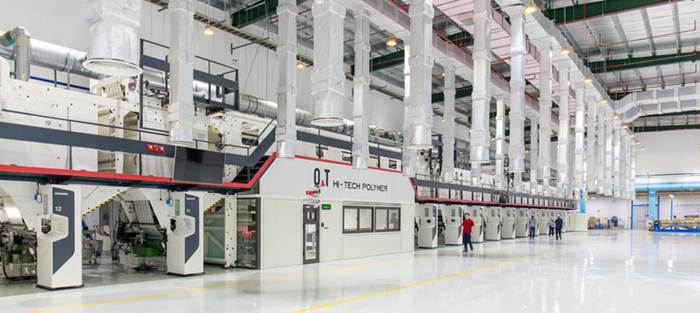
PolySecure® is manufactured at Q&T's purpose-built facility in Hanoi, commissioned in 2021 with the latest production technology. The factory operates on main grid electricity utilizing Vietnam's renewable energy mix, with the industry's only closed-loop solvent recovery system — achieving the lowest carbon footprint per substrate unit of any polymer manufacturer globally.
Learn more about our sustainabilityPolySecure's economic model extends proven polymer precedents from 45+ countries
"QT substrate demonstrated a 79.5% ± 11.4% improvement in relative mean life compared with a reference polymer substrate."
"Q&T Hi-Tech Polymer has emerged as an innovative new player in banknote polymer substrate technology."
"POLYSECURE SHIELD was spotlighted as a polymer banknote substrate with an embedded OVD."
PolySecure® is deployed in active banknote production rather than limited laboratory evaluation. Since August 2023, Q&T has supplied substrate for ten production contracts with Vietnam’s National Banknote Printing Plant, while independent benchmarking by UnderCurrency reported a +79.5% relative mean-life improvement versus a reference polymer substrate.
Substrate supply contracts executed with Vietnam’s National Banknote Printing Plant since August 2023.
Banknotes printed on Q&T substrate are currently circulating in the Vietnamese cash ecosystem.
Independent UnderCurrency assessment reported improved relative circulation durability versus the tested reference polymer substrate.
Currency-grade and commemorative international programmes reported across multiple markets under confidentiality agreements.
Production supply references since August 2023. Billions of Vietnamese banknotes printed on Q&T substrate are reported in active circulation.
PolyShield™ evaluation & integration
Our technical team can provide detailed specifications, test data, and a comprehensive cost-benefit analysis tailored to your denomination and circulation requirements.